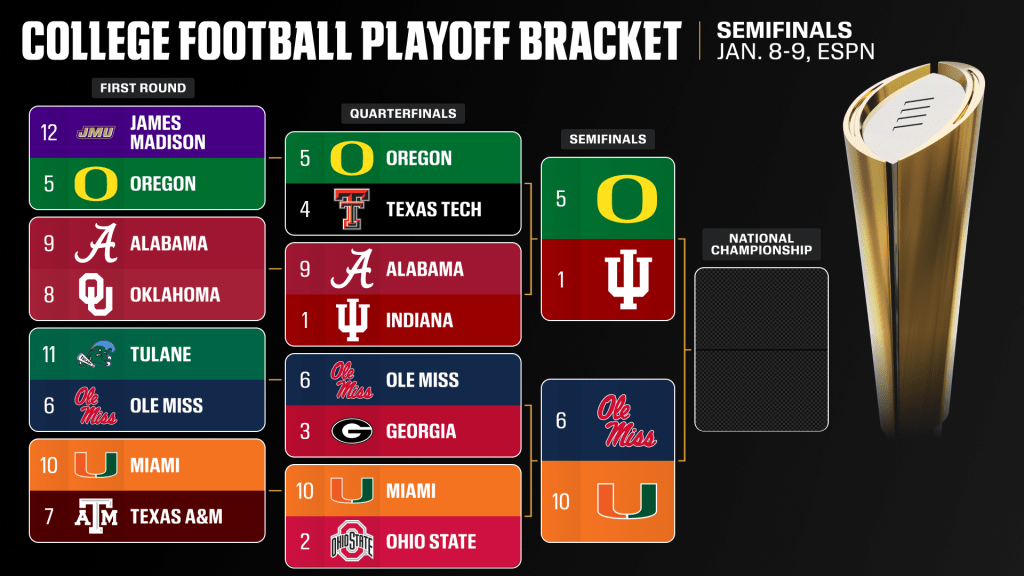
Tenth‑seeded Miami became the first double‑digit seed in the 12‑team era to reach the semifinals, muscling its way through the field by beating defending national champion Ohio State 24–14 on New Year’s Eve. Miami will face Ole Miss in the Vrbo Fiesta Bowl on January 8, kicking off at 7:30 on ESPN. Hurricanes coach Mario Cristobal, in his first playoff appearance, faces off against new Rebels coach Pete Golding, who piloted Ole Miss through choppy waters after the soap‑opera departure of Lane Kiffin.
Fifth‑seeded Oregon’s stifling defense shut down No. 4 Texas Tech, with freshman cornerback Brandon Finney Jr. picking off two passes and recovering a fumble to help the Ducks reach the Chick‑fil‑A Peach Bowl on January 9, also kicking off at 7:30 on ESPN. They’ll face No. 1 Indiana, which continued its storybook season by dispatching another of the sport’s blue bloods, No. 9 Alabama, in its first Rose Bowl appearance since 1968.
Now here’s a closer look at what to expect in each semifinal matchup.
Vrbo Fiesta Bowl: No. 6 Ole Miss vs. No. 10 Miami
Ole Miss Rebels (13–1)
What we learned in the quarterfinals Lane Kiffin turned out to be more garnish than main course at Ole Miss. His prowess as a playcaller is unquestioned, so it was fair to wonder how the Rebels would hold up without him—not just because of the controversy surrounding his departure or the split allegiances of an offensive staff still spending half its time with Ole Miss, but because Kiffin always had an exceptional game plan. It turns out: no Kiffin, no problem. The Rebels racked up 473 yards against Georgia’s stout defense, with strong performances through the air (362 yards from quarterback Trinidad Chambliss) and on the ground (98 yards and two touchdowns from running back Kewan Lacy). A fumble that led to a scoop‑and‑score and a botched fire‑drill field‑goal attempt late in the first half actually kept the game closer than Ole Miss’s offense might have otherwise made it.
X‑factor for Ole Miss Destiny. It would be easy to dissect the X’s and O’s, but here’s the more obvious storyline: Ole Miss feels like a team of destiny. Who could argue with a team whose lightning‑rod coach leaves for a big payday with a conference foe before the playoffs, only for a makeshift staff and determined roster to run the table anyway? It’s the ultimate feel‑good story, with Lane Kiffin cast as the villain and Pete Golding as the conquering hero. Ole Miss is talented enough to turn the fairy tale into reality, and yet it would still feel magical. College football always finds a way to deliver a little magic.
They can reach the national title game if… They can slow Miami’s pass rush. The secret sauce for the Hurricanes’ first two playoff wins was their defensive front. But will that be a major issue for the Rebels? Through the first three quarters of the Sugar Bowl, Georgia had only four pressures and no sacks despite 15 blitzed dropbacks. When the Bulldogs finally broke through early in the fourth quarter, Chambliss shrugged off the pressure to deliver a trio of nifty throws, including a 44‑yard completion that set up a touchdown. And Ole Miss did all this with Lacy nursing a shoulder injury that left him less than 100%. Still, Miami’s pass rush is better than Georgia’s, making the matchup between the Hurricanes’ dynamic defensive front and Chambliss one that could decide who advances.
Miami Hurricanes (12–2)
What we learned Miami is elite in the trenches. Rueben Bain Jr. and Akheem Mesidor, who combined for three sacks, terrorized the Ohio State offense off the edge as Miami shut out the Buckeyes in the first half. Ohio State had only one first down in the opening quarter and didn’t record positive rushing yardage until its fourth possession. Offensively, Miami’s line leaned on Ohio State’s athletic front and controlled time of possession. The Hurricanes ultimately outrushed the Buckeyes 153–45 and salted away the clock on the final drive. Miami is for real up front.
X‑factor for Miami Quarterback Carson Beck didn’t post big numbers—just 138 passing yards—but he continually delivered in key situations, especially on third down. On Miami’s game‑clinching touchdown drive, he converted two third downs with clutch completions. He also picked up first downs with his legs when nothing was open downfield. Most importantly, he didn’t turn the ball over. If he continues operating with this level of poise, Miami will be a tough out.
They can reach the national title game if… Their offensive and defensive lines keep dominating. With Bain and Mesidor leading the defense and All‑American center James Brockermeyer and right tackle Francis Mauigoa setting the tone on offense, Miami has the talent and experience to control the game up front—as Texas A&M and Ohio State both learned. The Hurricanes aren’t built for shootouts, but they have the physicality to impose their will. That formula could propel them to their first national title since 2001.
Chick‑fil‑A Peach Bowl: No. 1 Indiana vs. No. 5 Oregon
Indiana Hoosiers (14–0)
What we learned in the quarterfinals Any remaining doubts about Indiana’s ability to contend for—and win—its first national title evaporated in the rarefied air of the Rose Bowl. The Hoosiers clobbered Alabama in every facet, employing a balanced offense and stifling defense to overwhelm the Tide at the line of scrimmage. Indiana’s 10th‑ranked run game didn’t get enough attention, but running back Roman Hemby powered a ground attack that kept the offense out of difficult situations. Quarterback Fernando Mendoza, the Heisman Trophy winner, was excellent from the second quarter on, leading multiple long touchdown drives. Devan Boykin and others anchored a defense that again proved it’s one of the nation’s best and most consistent units.
X‑factor for Indiana Wide receivers Charlie Becker, Elijah Sarratt, and Omar Cooper Jr. headline the group, but Becker has surged late in the season and especially in the postseason. After posting his first two 100‑yard games against Penn State and Wisconsin, he led Indiana with 126 receiving yards against then‑No. 1 Ohio State in the Big Ten Championship. He added a leaping 21‑yard touchdown catch and a 30‑yard grab against Alabama.
They can reach the national title game if… They continue to control the line of scrimmage, maintain run‑pass balance, and limit big plays from Dante Moore and Oregon’s many weapons. Indiana beat Oregon by 10 at Autzen Stadium despite Mendoza throwing a pick‑six early in the fourth quarter. The game wasn’t truly that close—Oregon didn’t score an offensive touchdown for the final 50:15. Indiana must pressure Moore, who threw two interceptions in the first meeting but is capable of making every throw. The Hoosiers likely can’t afford another major mistake like Mendoza’s pick‑six, so playing clean and avoiding long‑yardage situations will be critical.
Oregon Ducks (13–1)
What we learned in the quarterfinals Oregon can play nasty defense, too. Coach Dan Lanning challenged the unit after it fell short of expectations in a 51–34 win over James Madison in the first round, when the Ducks allowed 500 yards of offense. The quarterfinals were a completely different story. Oregon forced four turnovers, recorded four sacks and seven tackles for loss, and posted its first bowl shutout since World War I. Brandon Finney Jr. had two interceptions and a fumble recovery, while Matayo Uiagalelei and Teitum Tuioti formed a fearsome edge‑rushing duo.
X‑factor for Oregon Tuioti has been outstanding in the second half of the season. The Ducks’ third‑leading tackler has seven sacks in his past six games and was especially disruptive against Texas Tech.
They can reach the national title game if… They find their rhythm on offense. Oregon didn’t play its best offensive game, but Texas Tech’s defense deserves credit for disrupting the Ducks, shutting down the run, and knocking them out of rhythm. Lanning also went for it eight times on fourth down, converting four. Aggression is one thing when you feel in control; it’s another when the game can swing on a single call. If Oregon can settle into an offensive groove, avoid too many fourth‑down gambles, and keep the defense attacking, they have a strong chance to advance.
Stay tuned for all the action in these two semifinal matchups on Thursday and Friday, January 8 and 9, on ESPN to find out who will advance to the national championship for the 2025 college football season.

 Little Miss Football
Leave a reply to Mike Barley Cancel reply