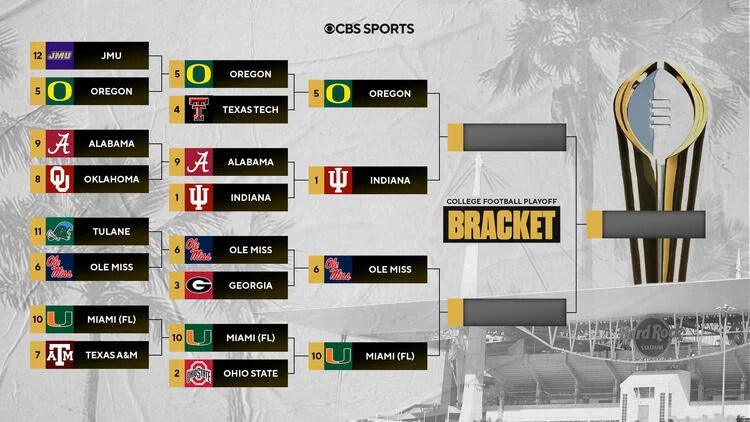
The second edition of the College Football quarterfinals gave us two classics and two statement wins. On Wednesday in the Goodyear Cotton Bowl Classic, tenth‑ranked Miami rode an early 14–0 burst and a clutch late touchdown drive to a 24–14 upset over second‑ranked Ohio State. The Hurricanes advanced to the semifinal round to face sixth‑ranked Ole Miss, which won an incredible back‑and‑forth Allstate Sugar Bowl 39–34 over third‑ranked Georgia on Thursday night.
On the opposite side of the bracket, in Thursday’s first two games, fifth‑ranked Oregon— a 2.5‑point favorite over fourth‑ranked Texas Tech—countered a strong defensive performance with an even better one in a 23–0 shutout in the Capital One Orange Bowl. Then, in Pasadena at the Rose Bowl Game presented by Prudential, top‑ranked Indiana throttled ninth‑ranked Alabama 38–3. We now have three first‑time College Football Playoff semifinalists, and the only team that has been here before (Oregon) is still searching for its first national title. We are living in a wild time in college football, that’s for sure.
Here is a deep dive into what we learned from each quarterfinal matchup.
Ole Miss 39, Georgia 34-
What just happened?
Ole Miss scored 20 fourth‑quarter points, avenged its only regular‑season loss, and advanced to the College Football Playoff semifinals for the first time. Trinidad Chambliss threw for 362 yards and two touchdowns, two different Rebels receivers topped 120 yards, the defense made a huge late stop, and Lucas Carneiro drilled three big field goals, including the game‑winning 47‑yarder with six seconds left.
After a slow start, Georgia used a 21–6 run to take a nine‑point halftime lead. Running backs Nate Frazier and Cash Jones combined for 124 yards on 14 touches to pace a physical attack. However, the Bulldogs scored only three points on their first four second‑half possessions, and a series of magical scrambles from Chambliss plus two touchdowns from Kewan Lacy allowed Ole Miss to take a 34–24 lead early in the fourth quarter. Georgia responded—as the Dawgs always do—quickly driving for a score, getting the ball back (with help from a dreadful missed facemask call), and driving again. But Ole Miss stiffened and forced a Peyton Woodring field goal with 56 seconds left, and a 40‑yard bomb from Chambliss to De’Zhaun Stribling set up Carneiro’s game‑winner.
See you next fall, Dawgs
In a way, Georgia was ahead of schedule. With a first‑year quarterback (Stockton), a sophomore running back (Frazier), a new offensive line, and a defense undergoing massive turnover for the second straight year, the Dawgs nearly lost twice in September and didn’t show much national‑title upside early. But the defense rounded into beautiful form late in the season, the Dawgs won their second straight SEC title, and they entered the College Football Playoff looking like a contender. Their second game against Ole Miss was even wilder than their first—a 43–35 Georgia win—and though they usually win brawls, they couldn’t win this one.
It appears they’ll return a lot of players in 2026, especially on a defense that unearthed several young stars. The 2021–22 champs will be disappointed with a second straight quarterfinal defeat, but they’ll be right back in the mix next year.
What’s next
Either Ole Miss or Miami will play for a national title. What a world. The Rebels and Hurricanes will meet in the Vrbo Fiesta Bowl next Thursday. It’s the first semifinal for both programs. Miami won the last meeting, but since it happened in 1950, it likely won’t matter much.
At first glance, this matchup is as fascinating as it is rare. Miami’s defensive front has dominated lately, and it will be interesting to see whether the Rebels can get Lacy going. Chambliss might be the best dual‑threat quarterback in the country right now, and his escapability could be crucial against Rueben Bain Jr. and Akheem Mesidor. Meanwhile, Miami’s power running game might find success, but if the Rebels stiffen in key moments again, they could force field goals and gain the edge. Either way, the lower half of the bracket will produce a team playing for its first title in either 24 years (Miami) or 63 years (Ole Miss).
Indiana 38, Alabama 3 –
What just happened?
The number one team played like the number one team. With Ohio State’s upset loss, Indiana becomes a significant national‑title favorite, and the Hoosiers weren’t about to let a three‑loss underdog get in their way. After an initial three‑and‑out, the Hoosiers scored on six of their next seven possessions, and they didn’t allow the Crimson Tide to score until late in the third quarter—after they had knocked Alabama quarterback Ty Simpson out of the game. Indiana’s first Rose Bowl trip in 58 years ended like most Indiana games this season: with backup quarterback Alberto Mendoza playing.
See you next fall, Tide
Alabama played poorly all season, often winning by narrow margins and gutting out close games. It took a 4–1 record in one‑score games and, yes, a friendly College Football Playoff committee that chose not to drop the Tide after their blowout loss in the SEC Championship Game to get them into the quarterfinals. But it wasn’t the first time a Kalen DeBoer team relied on toughness and game management—he’s good at that.
A team with Alabama’s blue‑chip talent, however, shouldn’t have to rely on scrappy play. The Tide never established a ground game this season—Alabama backs had just eight carries for 15 yards on Thursday—and Simpson seemed to wear down late in the year after carrying so much of the load. The defense was very good but not elite, and against top‑four teams in the SEC title game (Georgia) and Rose Bowl (Indiana), the Tide lost by a combined 66–10. Alabama has maintained a high level since DeBoer replaced Nick Saban two seasons ago, but the Tide still underachieved. It will be fascinating to see what DeBoer does to close the gap between production and expectation.
What’s next
Curt Cignetti’s Hoosiers have passed every test this season, and now they face a new one: a rematch. They’ll play Oregon in the Peach Bowl on January 9. Indiana won 30–20 in Eugene on October 11; Oregon’s Brandon Finney Jr. scored on a 35‑yard pick‑six to tie the game early in the fourth quarter, but a Mendoza‑to‑Sarratt touchdown put Indiana ahead with 6:23 left, and after an immediate interception, Indiana sealed the win with a short field goal.
The Hoosiers outgained the Ducks by 59 yards and controlled the second half, but with two playoff wins by a combined 40 points, Oregon is in fine form. Both teams play fast, physical football, and though Indiana will be deservedly favored, it should be a terrific matchup.
Oregon 23, Texas Tech 0 –
What just happened?
Oregon kicked a field goal in the first quarter, and the game was essentially over. Texas Tech’s defense played heroic football, but the Ducks dominated the Red Raiders’ offense so thoroughly that nothing else mattered. Oregon allowed just 215 total yards, forced four turnovers, and stopped Texas Tech on three fourth‑down attempts. The Ducks’ only touchdowns came on drives of six and 28 yards, and they still haven’t done much damage against elite defenses in 2025. But their elite defense carried the day.
What’s next
Oregon now gets a revenge opportunity: a Peach Bowl rematch against Indiana. The Ducks’ offense will face the burden of proof, as they averaged just 4.2 yards per play against Indiana the first time and 3.8 against Texas Tech. But the defense will likely be up for the challenge.
Miami 24, Ohio State 14 –
What just happened?
Miami combined steady, efficient offense with a 72‑yard Keionte Scott pick‑six to race to a 14–0 lead. When Ohio State rallied to within 17–14 in the second half, the Hurricanes responded with a perfect five‑minute, 70‑yard touchdown drive to ice the game.
Miami’s defense dominated early. Star ends Rueben Bain Jr. and Akheem Mesidor combined for three sacks in the first half, and Ohio State punted on four of its first five drives. After Julian Sayin hit Jeremiah Smith for a 59‑yard bomb in the second quarter, Scott jumped a telegraphed screen pass and took it the other way for a score.
The second half was a battle of toughness. Ohio State established a solid run game and got more big catches from Smith—who finished with seven receptions for 157 yards and a touchdown—and crawled back to within 17–14. But Miami turned to burly North Dakota State transfer CharMar Brown; in his first six touches of the College Football Playoff, he gained 31 yards. After the Hurricanes converted third‑and‑four and third‑and‑three, Brown scored from five yards out with 55 seconds left.
See you next fall, Buckeyes
Ohio State’s season was almost perfectly crafted for another national‑title run. The Buckeyes survived a rock fight against Texas in Week 1, then won their next 11 games by an average of 39–8. And though they lost to Indiana in the Big Ten Championship Game, they still appeared poised for a title run. Instead, they fell victim to a growing trend: in the first five quarterfinal games of the 12‑team playoff era, teams with first‑round byes have fallen behind early—14–0 (Boise State vs. Penn State), 34–0 (Oregon vs. Ohio State), 17–3 (Arizona State vs. Texas), 20–3 (Georgia vs. Notre Dame), and now 14–0 (Ohio State vs. Miami). The first‑round bye, combined with a neutral‑site bowl, has not yet proved to be a reward. Miami took the fight to the rusty Buckeyes early and was rewarded.
Ohio State heads into 2026 in excellent shape. Sayin will return after throwing for 3,610 yards and 32 touchdowns in 2025 (he had 287 yards and one touchdown Wednesday night), and major stars such as Smith and running back Bo Jackson (11 carries for 55 yards) should be back as well. The Buckeyes are built to compete every year in a 12‑team playoff era.
What’s next
After becoming the first double‑digit seed to win a playoff game, Miami has now become the first to reach a semifinal as well. It was very much in doubt whether Mario Cristobal’s Hurricanes would make the College Football Playoff at all, but they’ve made the most of the opportunity. They’ll play Ole Miss in the Vrbo Fiesta Bowl.
This was, quite simply, the biggest Miami win since 2002. With loads of former Hurricane greats on the sidelines—including Michael Irvin, Ray Lewis, and former coach Jimmy Johnson—college football history was very much present in Arlington. And the Hurricanes managed to overcome both ghosts and Ohio State’s talent to survive and advance.
That’s all we learned from the quarterfinals of the College Football Playoff. Stay tuned for the semifinal round of the 2025 College Football Playoff, taking place on Thursday, January 8, and Friday, January 9.


Leave a Reply