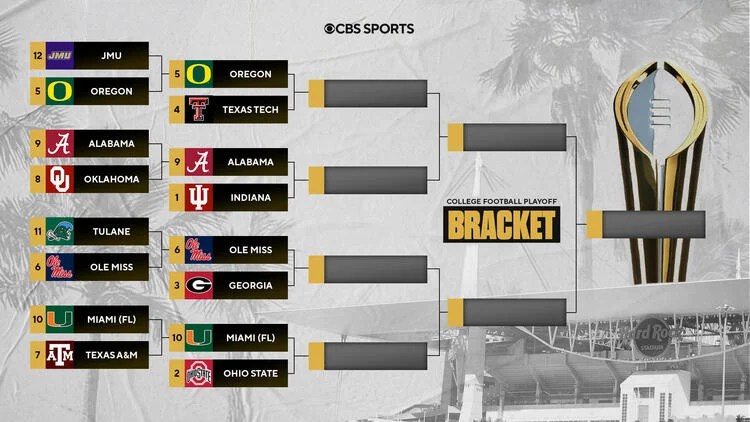
The first round of the 2025 College Football Playoffs is complete. After last year’s run of home blowouts, we saw the opposite in the first two matchups—nip‑and‑tuck ballgames with wild special teams swings and, thanks in large part to turnovers, a pair of road victors (after home teams went 4–0 in the first round last year). Alabama pulled off a 17‑point comeback to beat Oklahoma 34–24 on Friday night, then Miami survived the ultimate battle of attrition in College Station, beating Texas A&M 10–3.
That wasn’t the case in the final two games. Ole Miss overwhelmed Tulane in their first game without coach Lane Kiffin. Rebels quarterback Trinidad Chambliss accounted for more than 300 total yards and three touchdowns in the 41–10 victory. Oregon jumped out to a huge first‑half lead against James Madison and cruised to an easy 51–34 win. Now let’s dive into the main takeaways from the first round of the 2025 College Football Playoffs.
Oregon 51, James Madison 34
What just happened?
Over the past three seasons, Oregon has gone a combined 37–4 with losses only to a national champion (2024 Ohio State), a national finalist (2023 Washington, twice), and the current unbeaten No. 1 seed (Indiana). If you aren’t a genuine title threat, you evidently don’t have a chance against the Ducks—and James Madison most certainly didn’t have a chance Saturday night in Eugene.
The Dukes, making their playoff debut, acquitted themselves well enough on offense, eventually gaining 509 yards and scoring 34 points despite leaving a few points on the board with failed red‑zone opportunities. But their defense, so good within the Sun Belt, was obliterated by an early stream of Oregon big‑play threats. JMU pulled off a pretty high‑wire act in 2025, taking risks, keeping defenders in the box, and leaving their perimeter defenders isolated. They got away with it against Louisville, allowing just 264 yards and 21 offensive points. But Oregon’s offensive line is much better than Louisville’s, and JMU couldn’t create any disruption. They only left the big plays. In the first half, the Dukes created zero tackles for loss and gave up five gains of 30‑plus yards.
Oregon scored touchdowns on its first five possessions and didn’t punt until midway through the third quarter. Dante Moore made great throws, and when he didn’t, his receivers made great catches—his first 13 completions gained 307 yards. JMU made things annoying in garbage time, gaining 194 fourth‑quarter yards and giving Oregon coach Dan Lanning a few things to yell about over the next few days, but the Ducks had this one put away early.
See you next fall, Dukes
The financial gap between mid‑majors and the richest power‑conference programs has grown immensely over the past 15 years, and with the upward stream of talent in this transfers‑and‑NIL universe (not to mention coaches such as JMU’s UCLA‑bound Bob Chesney), it is harder than ever for a Group of Five team to hint at elite play like Boise State, TCU, or Utah did in the late 2000s. (That said, a reminder: The Dukes would have been projected favorites over ACC champion Duke. We still might have gotten a better playoff with its inclusion.)
JMU is built to continue playing at a high level within the Sun Belt, especially with Billy Napier—author of a particularly physical and impressive run at Louisiana before his tenure at Florida—taking over. But the Dukes got a pretty clear indication of what might await if or when they make another run toward the College Football Playoffs.
What’s next
When the playoff field was revealed two weeks ago, the first thing that caught my eye was the tantalizing prospect of an Oregon–Texas Tech quarterfinal. Oregon is still relatively new money as far as college football blue bloods go; Texas Tech is brand‑new money. They’ve done some of the best portal work in the country. They will meet in the Orange Bowl on January 1.
The question stands: Can Oregon play the same type of precise and ridiculously fast ball against a Texas Tech defensive front that hasn’t been beaten much this season? Can Behren Morton and Texas Tech’s explosive yet inconsistent offense take what they’re given and avoid forcing the issue too much against an Oregon defense that prevents big plays and punishes impatience? It’s the most interesting quarterfinal matchup.
Ole Miss 41, Tulane 10
What just happened?
Ole Miss’ offense was simply too sharp, and Tulane’s Jake Retzlaff was too error‑prone. In front of a record Vaught‑Hemingway Stadium crowd of 68,201, the Rebels gained 135 yards on their first seven snaps and bolted to a 14–0 lead. Tulane held up for the rest of the first half and, trailing 17–3 at halftime, had a chance to get back into the game to start the second half. Instead, the Green Wave punted, turned the ball over on downs, and lost two fumbles—both by Retzlaff. The Rebels were happy to capitalize on short fields and run up the score.
As his former school, Ferris State, was almost simultaneously winning another Division II national title, Ole Miss quarterback Trinidad Chambliss played an almost perfect game. Despite missing a few snaps because of an injury at the end of the first half, he completed 23 of 29 passes for 282 yards and a touchdown while gaining 51 yards on four non‑sack rushes. Running back Kewan Lacy also missed time because of a shoulder injury but returned and finished with 87 yards on just 15 carries. A deep receiving corps got strong games from Dence Alexander, De’Zhaun Stribling, and tight end Dae’Quan Wright, who combined for 16 catches and 230 yards. Tulane’s offense made far too many mistakes, but it probably wouldn’t have mattered—the Rebels were going to score too much regardless.
See you next fall, Green Wave
This was obviously a terribly disappointing finish to the Joe Sumrall era. The newly hired Florida coach led the Green Wave to 20 wins in two seasons, plus a conference title (and wins over Northwestern and Duke) this season. But his team just wasn’t sharp on Saturday. Missed tackles, dropped passes, and quarterback mistakes weren’t a good reflection of how well they played down the stretch to secure a bid.
Still, Tulane has positioned itself as one of the strongest programs in the Group of Five. The Green Wave have won 43 games in four seasons under first Willie Fritz and then Sumrall. Now Will Hall, a former Fritz and Sumrall assistant, takes over. He’ll have to weather the transfer‑portal raids as power‑conference programs come for successful Group of Five talent, but the Green Wave are as well‑positioned as anyone to keep winning.
What’s next
Ole Miss played well down the stretch as rumors swirled around Lane Kiffin’s potential departure, and in their first game post‑Kiffin, they were absolutely dynamite. Now they get a chance to avenge their only loss of 2025. In a 43–35 loss to Georgia back in Week 8, the Rebels led by nine entering the fourth quarter until the Dawgs turned the tables late. Now Ole Miss and Georgia will face off in the Sugar Bowl on January 1.
The key to revenge could be the Ole Miss run defense. Georgia cranked out 221 rushing yards against the Rebels, setting up Gunner Stockton with healthy downs and distances, and he responded by going 26‑for‑31 for 289 yards and four touchdowns (plus 59 rushing yards of his own). Run defense has been a weakness all season, and Tulane’s Jamauri McClure found some success Saturday evening, rushing 15 times for 84 yards. Chambliss certainly learned some lessons in Athens, and the Rebels’ offense doesn’t mind a track meet. But forcing the Dawgs off‑schedule will be key to an upset and a trip to the semifinals.
Miami 10, Texas A&M 3
What just happened?
Three of the sloppiest, windiest, most war‑of‑attrition quarters in recent college football history were followed by an incredible, dramatic fourth quarter. Miami’s Mark Fletcher Jr. rushed 17 times for 172 yards, and his 56‑yard charge with 4:01 left set up the game’s only touchdown—an 11‑yard jet sweep from Malachi Toney. It looked as if A&M would force overtime or score and go for two and the win, but Bryce Fitzgerald picked off a misplaced Marcel Reed pass in the end zone with 23 seconds left, and the Hurricanes kneeled out a road win.
In extremely windy conditions, the first three quarters featured more missed field goals (four) than points (three), but a nice run of passes from Reed set up Randy Bond’s game‑tying 35‑yarder. Toney’s fumble near midfield with 7:11 left seemed to set the Aggies up for a major opportunity. But Rueben Bain Jr. recorded his third sack of the game to force a punt that set up heroics from Fletcher and redemption for Toney.
See you next fall, Aggies
Sometimes you peak a little too early. Texas A&M moved to 9–0 in early November with wins over LSU and Missouri, but the Aggies underachieved in their last four games. They needed a huge comeback to beat South Carolina, then scored just 20 combined points in losses to Texas and Miami. The defense had big‑play issues at times—something Fletcher certainly took advantage of—but when you give up ten total points, you expect to win every time.
Still, a disappointing finish doesn’t negate the fact that the Aggies were ahead of schedule this fall. Starting Mike Elko’s second season at 19th in the AP poll, A&M won 11 games for the first time since the Johnny Manziel‑led 2012 campaign. The Aggies went 12–13 in Jimbo Fisher’s last two years, but Elko is now 19–7, and A&M probably won’t be starting a season ranked 19th or lower for quite a while. Elko will head into 2026 with two new coordinators after defensive coordinator Jay Bateman left for Kentucky and offensive coordinator Collin Klein took the Kansas State head‑coaching job. Elko will also have to replace serious talent in the trenches, led by star defensive end Cashius Howell. But the passing game is primarily underclassmen, and the pass‑rushing talent doesn’t stop at Howell. Elko’s building job should continue.
What’s next
The Hurricanes meet No. 2 Ohio State in the Cotton Bowl on December 31. With Bain’s incredible play and Miami’s generally fantastic defensive performance, there’s reason to believe they could keep the Buckeyes’ point total down. But Ohio State’s defense is the best in the country; it held Heisman winner Fernando Mendoza and Indiana to 13 points in the Big Ten Championship Game and has allowed 300 total yards just twice in 13 games. The Buckeyes won’t offer Fletcher the same big‑run opportunities, so Beck will have to make all the plays he didn’t make Saturday afternoon. Can he?
Those are questions for New Year’s Eve. For now, Miami gets to celebrate its most momentous win since—when, 2002? Mario Cristobal’s Hurricanes fell just short of the College Football Playoffs in 2024 and very easily could have missed out this year as well. But they snagged a bid, and in a windy battle of wills in College Station, they held their nerve and avoided the mistakes that A&M could not.
Alabama 34, Oklahoma 24
What just happened?
Oklahoma’s offense had only 20 minutes in it. The Sooners were perfect out of the gate, bursting to a 17–0 lead against an Alabama team that looked completely unprepared for the moment. But the Crimson Tide adjusted and rallied, and Oklahoma had only a brief answer. From 17 down, Alabama outscored its host 34–7 the rest of the way.
Over the first 19 minutes, Oklahoma went up 17–0 while outgaining Alabama by a stunning 181–12 margin. It could have been worse, too, as the Sooners’ Owen Heinecke came within millimeters of a blocked punt that might have produced a safety or touchdown.
Over the next 21 minutes, Alabama outscored the Sooners 27–0, outgaining them 194–59. Freshman Lotzeir Brooks caught two touchdown passes—the first on a fourth‑and‑two to finally get Alabama on the board (after he caught a huge third‑down pass earlier in the drive), and the second on a 30‑yard lob that put the Crimson Tide up for good. The Tide defense got pressure on John Mateer, and his footwork and composure vanished. A pick‑six tied the score, and Alabama scored the first ten points of the second half as well.
See you next fall, Sooners
We knew that whenever Oklahoma’s season ended, offense would be the primary reason. The Sooners survived playing with almost no margin for error for most of the year.
The defense still played well Friday night—Alabama gained only 260 total yards—but special‑teams miscues put more pressure on the offense, and after a brilliant start, it ran out of steam. Mateer began the game 10‑for‑15 for 132 yards with a touchdown, 26 rushing yards, and a rushing touchdown, but his last 31 pass attempts gained just 149 yards with five sacks and a pick, and his last nine non‑sack rushes gained just 15 yards.
Brent Venables heads into the offseason facing some decisions. Oklahoma’s offense technically improved after the big‑money additions of coordinators Ben Arbuckle and Mateer, but Mateer was scattershot before his midseason hand injury and poor after it. Do the Sooners run it back with the same roster core, hoping that better health and an improved run game can give the defense what it needs to take Oklahoma to the next level? Does Venables hit the reset button again? Can he ever get the arrows pointed in the right direction at the same time?
What’s next
Alabama’s reward for the comeback win is a trip out West: The Crimson Tide will meet unbeaten and top‑seeded Indiana in the Rose Bowl on January 1. Alabama’s defense will obviously face a stiffer test from Heisman winner Fernando Mendoza and the Hoosiers’ attack, but Alabama’s defense has been mostly up for the challenge this season. The Tide’s ability to pull an upset will be determined by Ty Simpson and the Alabama passing game.
Simpson began Friday night’s win just 2‑for‑6 with a sack, and though he improved from there and didn’t throw any interceptions, his final passing line—18‑for‑29 for 232 yards, two touchdowns, and four sacks—still showed footwork issues and several misfires. Oklahoma’s pass rush is fearsome, but Indiana’s defense ranks seventh in sack rate with almost no blitzing. The Hoosiers generate pressure and clog passing lanes, and they held Oregon’s Dante Moore and Ohio State’s Julian Sayin to 5.1 yards per dropback with 11 sacks, two touchdowns, and three picks. Alabama will be an underdog for good reason.
But kudos to the Tide for getting off the mat. They were lifeless at the start—missing tackles and blocks and looking as unprepared as they did in their season‑opening loss to Florida State. But Brooks’ playmaking lit the fuse, and Alabama charged back.
That’s everything we learned from the first round of the 2025 College Football Playoffs. Stay tuned for what’s in store for the quarterfinal round kicking off on New Year’s Eve

 Little Miss Football
Leave a reply to Mike Barley Cancel reply